Playgrounds That Draw More Visitors To Holiday Parks & Attractions
For hospitality destinations competing for family bookings, playgrounds now play a larger role in the overall guest experience. More operators are investing in outdoor play areas designed to appeal to a wider range of visitors, with accessible design increasingly recognised as a smarter way to improve appeal, dwell time and overall site performance.
See if your playground could be attracting more families:
Why guests are increasingly choosing destinations based on inclusive facilities
How inclusive play is simply equipment designed to be used by more people
Why popular family destinations are turning to inclusive play
How accessibility is becoming a bigger focus for UK tourism performance
How to create holiday park & attraction playgrounds that don’t feel segregated
Guests Are Increasingly Choosing Destinations based On Inclusive Facilities
An estimated 1 in 4 households in the UK include someone with a disability or long-term health condition.
For many families, the decision between holiday parks is no longer just about location or price. It increasingly depends on whether everyone in the group can comfortably use the facilities once they arrive.
Research suggests accessibility continues to influence booking decisions across the UK, with 67% of families with accessibility requirements reporting ongoing difficulties when planning travel (TransReport, 2025).
As a result, parks that offer more accessible outdoor play are better positioned to secure bookings earlier in the decision process and reduce hesitation at the point of comparison.
Accessibility should not be seen as a niche consideration. Research from Responsible Travel suggests two in five UK adults now travel with health or accessibility needs in mind.
“Inclusive play is not a separate or specialist concept” explains Amy, Design Manager at Creative Play. “It is a design approach that allows more families to use the same playground at the same time, without changing the overall feel or quality of the space”.
The Equality Act 2010 considers a person to have a disability
“if they have a physical or mental impairment that has ‘substantial’ and ‘long term’ negative effects on their ability to do normal daily activities”.
Inclusive Play Is Simply Equipment Designed To Be Used By More People
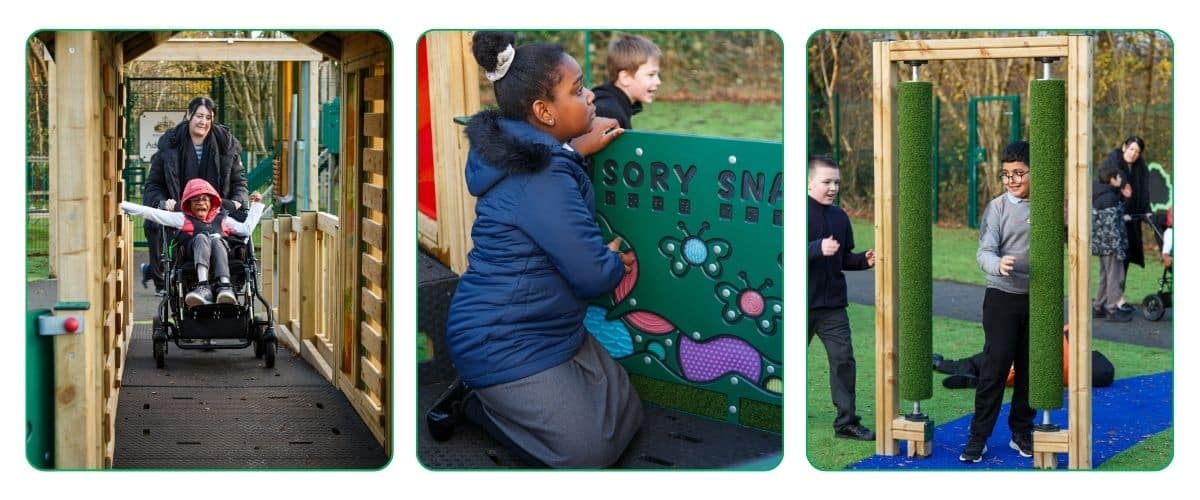
Inclusive playground design does not rely on separate areas or specialist installations. Instead, accessibility is built into mainstream play equipment, so it remains familiar, practical and commercially viable, while allowing more families to use it comfortably together.
“This typically includes features such as accessible routes, ground-level activities and sensory elements within standard play structures,” explains Amy. “It allows children of different abilities to play in the same space.”
The result is simple – the same footprint works harder, without adding operational complexity or changing how the site is managed.
“Creative play brought our vision to life with a bespoke design and understood the site.”
Why Popular Family Destinations Are Turning To Inclusive Play
For many holiday parks and attractions, inclusive playground design is becoming a more considered approach to new play investment, driven by its ability to widen usability without changing how the space is used or managed.
“Rather than creating play equipment that only serve part of the market, inclusive design increases the usability of the same play space” explains Creative Play Outdoor Play Advisor Josh, “allowing more families to engage with it at the same time”.
A report by Omnipods found that 71% of people with disabilities want to vary their holidays by trying new destinations but often return to familiar places due to uncertainty around whether alternative locations can meet their needs.
In practical terms, this means destinations that meet accessibility expectations are better positioned to capture demand that would otherwise default elsewhere.
“Inclusive playgrounds do not require separate zones, specialist-looking equipment or major operational changes” Josh adds. “Accessibility features are now commonly integrated into mainstream commercial play environments, creating spaces that feel welcoming, practical and relevant to a wider audience”.
For holiday parks, the focus is increasingly on making existing investment work harder – extending the value of a single play area through broader usability rather than additional footprint.
As noted in the Omnipods research, Paul Nadin, CEO of Disabled Holidays, reports that 19% of customers are unable to find availability that meets their requirements, rising to 50% in more popular destinations.
The same report also highlights that some operators investing in accessible tourism facilities have seen a 20% increase in occupancy.
“A great experience working with Creative Play. Communication was excellent, the design work was thoughtful and well planned, and the finished installation is of high quality. It has noticeably improved both visitor safety and the overall experience.”
Accessibility Is Becoming A Bigger Focus For UK Tourism Performance
Tourism bodies and government initiatives continue to encourage destinations to improve accessibility as part of the wider visitor offer.
The government website states that if tourism is to “continue flourishing, it needs to ensure that facilities are accessible to all visitors. With one in 5 people in the UK living with a disability or health condition, there is a clear business case for ensuring that disabled people’s needs are catered to”.
It also highlights several destinations already leading in this area, including Sandcastle Waterpark in Blackpool, Cottage in the Dales in Newbiggin, and Eureka! The National Children’s Museum in Halifax.
This reflects a wider shift across the sector, where accessibility is increasingly being treated as part of destination performance rather than a standalone provision.
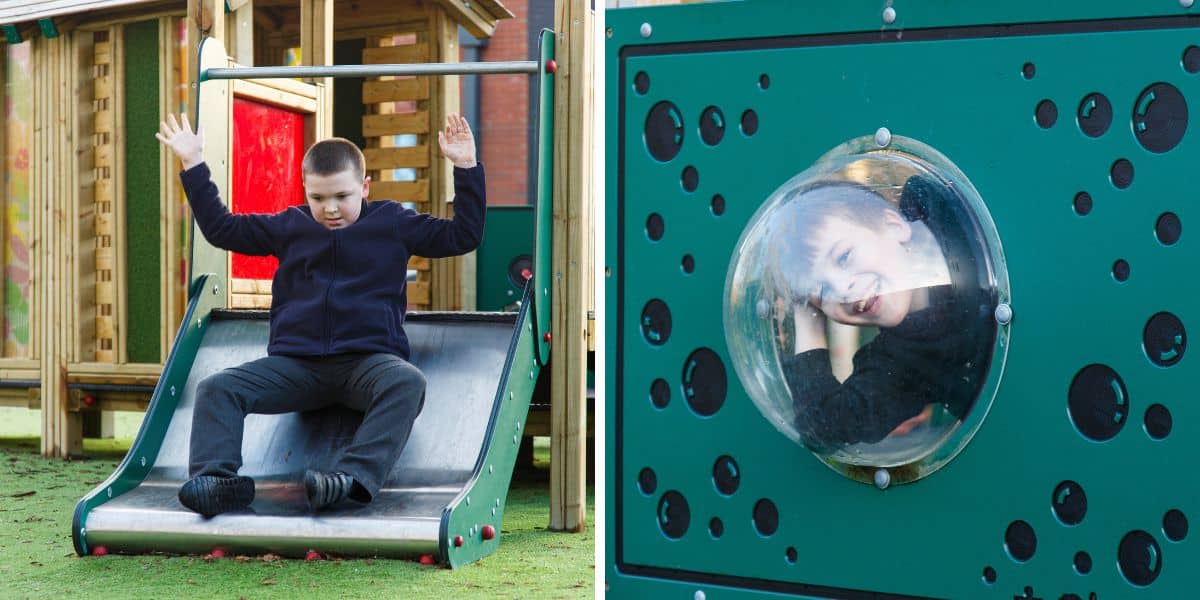
“Feedback from parents has been very positive, with the multi-play unit offering more features and play opportunities than the previous traditional slide.”
Creating Holiday Park & Attraction Playgrounds That Don’t Feel Segregated
One reason some parks have historically been cautious about accessible play is the assumption that it results in equipment that feels specialist or visually separate from the wider site experience.
The latest inclusive outdoor play equipment has been developed in collaboration with a specialist SEN school to combine accessibility, challenge and shared play within integrated structures. The result is equipment that feels contemporary, engaging and commercially appropriate for family destinations.
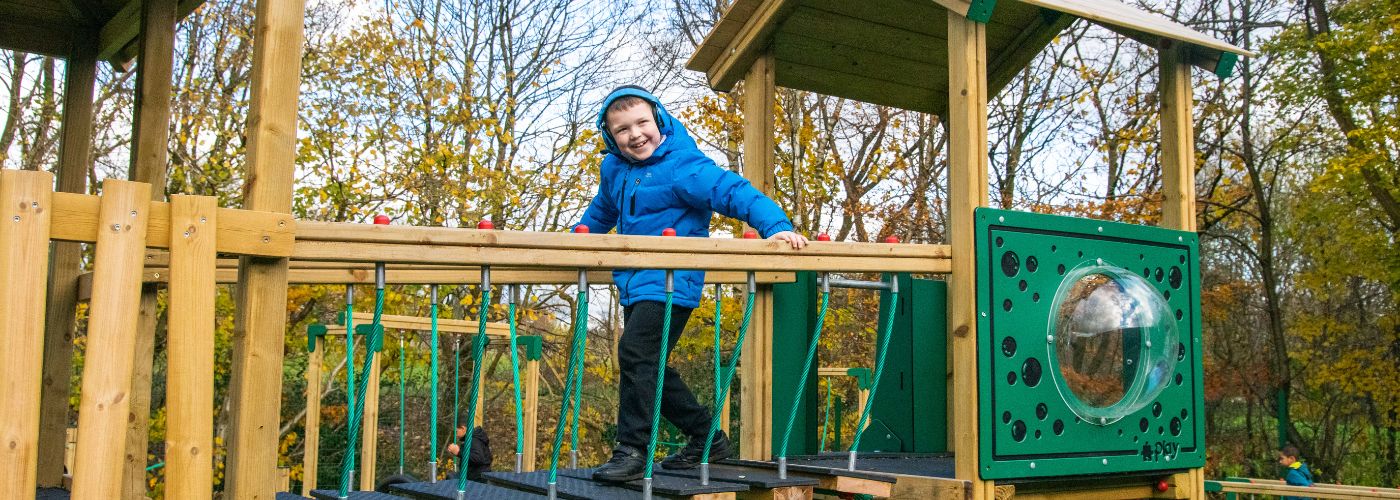
Rather than separating accessibility from play value, inclusive features are embedded into the equipment and layout itself, allowing more families to use the space together without compromising visual appeal or play quality.
The outcome is a playground that broadens usability while still delivering the standard of environment expected in leading holiday parks and attractions.
Could Your Playground Be Attracting More Families?
While most holiday parks and visitor attractions recognise playgrounds as a strong investment, some may not be capturing the full value available from their space.
In competitive local markets, this can influence booking decisions and on-site engagement more than is often assumed.
Want to know what this could look like for your site? Creative Play can provide clear design concepts, layout ideas and itemised pricing tailored to your requirements.
We use technologies like cookies to store and/or access device information. We do this to improve browsing experience and to show (non-) personalised ads. Consenting to these technologies will allow us to process data such as browsing behaviour or unique IDs on this site. Not consenting or withdrawing consent, may adversely affect certain features and functions.
Functional
Always active
The technical storage or access is strictly necessary for the legitimate purpose of enabling the use of a specific service explicitly requested by the subscriber or user, or for the sole purpose of carrying out the transmission of a communication over an electronic communications network.
Preferences
The technical storage or access is necessary for the legitimate purpose of storing preferences that are not requested by the subscriber or user.
Statistics
The technical storage or access that is used exclusively for statistical purposes.The technical storage or access that is used exclusively for anonymous statistical purposes. Without a subpoena, voluntary compliance on the part of your Internet Service Provider, or additional records from a third party, information stored or retrieved for this purpose alone cannot usually be used to identify you.
Marketing
The technical storage or access is required to create user profiles to send advertising, or to track the user on a website or across several websites for similar marketing purposes.