How Outdoor Play Equipment Aids The EYFS 7 Areas Of Learning And Development
In the Early Years Foundation Stage, outdoor provision is not an ‘extra’, it is a key part of how children meet curriculum expectations. For schools, this creates a clear challenge – ensuring that outdoor provision doesn’t just offer opportunities for play, but actively supports and evidences progress in line with EYFS requirements, continuous provision principles, and Ofsted expectations.
This often raises a practical question for schools: how clearly does your outdoor space demonstrate this in day-to-day practice?
The below guide sets out how well-designed outdoor environments contribute to each of the seven areas of learning, combining statutory framework guidance with practical insight from real play settings. It highlights what effective provision looks like in practice, and how everyday outdoor experiences translate into observable outcomes for children.
Outdoor provision supports development across all 7 EYFS areas:
Communication and Language
Physical Development
Personal, Social and Emotional Development
Literacy
Mathematics
Understanding the World
Expressive Arts and Design
1. Communication And Language
The statutory framework for the Early Years Foundation Stage recognises the importance of communication and spoken language as fundamental across all seven areas of learning. The verbal interactions of very young children ‘form the foundations for language and cognitive development’. This aligns with expectations for practice within the prime areas of learning, where communication and language form a foundation for all further development.
Frequent conversations with peers play a key role in this development. Through shared stories and everyday interaction, children are given ‘extensive opportunities to use and embed new words in a variety of contexts’, which supports their ability to thrive. As a result, they become more confident ‘using a rich range of vocabulary and language structures…through conversation, story-telling and role-play, where children share their ideas’.
This is where the outdoor environment becomes particularly powerful, turning communication from something structured into something natural, continuous, and child-led.
How Outdoor Play Equipment Helps Children Develop Communication And Language Skills
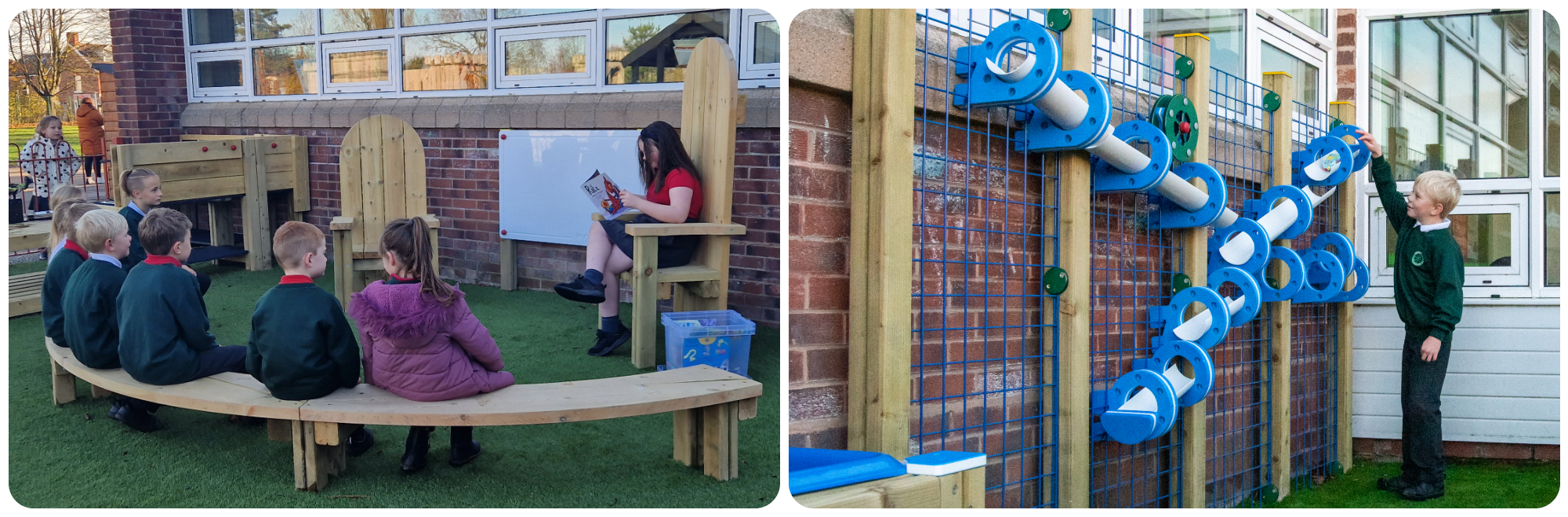
‘Playing outdoors is the natural setting for children to practise their communication skills within continuous provision’, says Creative Play’s Tim. ‘Being away from the classroom allows them to apply what they have learned in a practical way. When they are playing together outdoors, the possibilities for communication and language are endless’. In many settings, this is most evident where outdoor environments prompt sustained back-and-forth interaction, natural opportunities for children to speak, listen and respond to one another throughout the day, rather than short or one-word exchanges.
Some outdoor play equipmentdirectly encourages verbal interaction, such as talk tube panels, which prompt children to communicate across a short distance. However, many other types of outdoor equipment support communication in less obvious but equally important ways.
‘In a sandpit, you’ll often see children talking continuously about what they are building or creating together. With messy play tables, they naturally begin asking each other to pass tools or materials. Water play tends to trigger cooperation and shared decision-making, while climbing equipment often leads to discussion about how to move safely and include others’, explains the Outdoor Play Expert.
More imaginative equipment also plays a key role. ‘Castles and Viking ships’, says Tim, ‘bring children together through role-play, encouraging them to use language from entirely different contexts. It helps develop creativity and problem-solving, as well as the kind of communication skills they will need as they progress through the school system’.
In practice, this is often most noticeable in how children naturally cluster around certain areas of the playground. For example, in one setting, staff observed that a group using a sand and water zone began narrating their play continuously, negotiating roles, describing actions, and problem-solving aloud without adult prompting. What began as simple play quickly developed into sustained conversation, with children responding to each other’s ideas rather than working in isolation.
Outcome: Communication And Language
By the end of the EYFS, and as set out in the ELG criteria, children will typically demonstrate communication and language development through outdoor play by:
Engaging in conversation with their peers, comfortably participating in back-and-forth exchanges
Participating in small group discussions and sharing their own ideas based on recently introduced vocabulary
Using full sentences to express thoughts and emotions
2. Physical Development
A key part of children’s development within the statutory framework is physical activity, which it describes as ‘enabling them to pursue happy, healthy and active lives’. This is a key component of the prime areas of learning, underpinning both physical competence and readiness for later academic skills such as writing.
Early childhood is a critical period for developing gross and fine motor skills, ‘starting with sensory explorations and the development of a child’s strength, coordination and positional awareness through tummy time, crawling and play movement… Gross motor skills provide the foundation for developing healthy bodies and social and emotional well-being. Fine motor control and precision help with hand-eye coordination, which is later linked to early literacy’.
Structured play experiences and regular outdoor activity help schools ‘support children to develop their core strength, stability, balance, spatial awareness, coordination and agility’, enabling children to ‘develop proficiency, control and confidence’.
How Outdoor Play Equipment Aids The Physical Development Of Children
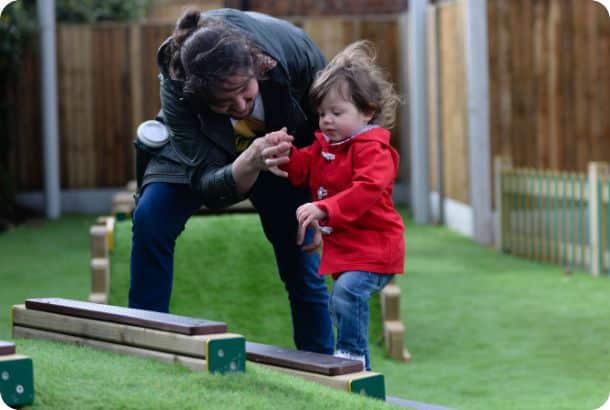
‘New experiences mean putting different muscles to work, ones which have likely never been used before by small children’, points out Outdoor Play Expert Tim. ‘For many of them, this is their first exposure to play, so we need to accommodate that timid approach they are making towards trying something new’. This is often where observational assessment of gross and fine motor development becomes most evident in practice.
He adds: ‘Just imagine what it’s like for a young child walking a balance board for the first time. The fear, risk, and challenge followed by belief and confidence. As amazing as it is for developing strength and agility, it’s as much a psychological journey as it is a physical one’.
Outdoor activity also plays a wider health role. ‘Play equipment that encourages a lot of physical activity is great for combating obesity, but the physical benefits go way beyond that’, continues Tim. ‘We really need to help develop those gross and fine motor skills’.
Everyday movements and play scenarios all contribute. ‘Playing with rope, for example, not only aids in developing hand-eye coordination, but the very act of using their hands in this way for the first time helps prepare them for ‘pinching’ a pencil – something they will need to be ready for when they begin school. The same goes for leg muscles, they need regular exercise so that children can go on to develop skills such as riding a bicycle’.
He also highlights foundational movement skills. ‘There are some children who need help getting used to using stairs, which is another one of those skills EYFS requires providers to prepare them for before attending school. The developmental benefits of playing on an adventure trail twice a day truly are incredible!’
Where this is well supported, children will return to challenging activities repeatedly, building control and confidence over time rather than avoiding them.
Outcome: Physical Development
By the end of the EYFS, and as set out in the ELG criteria, children will typically demonstrate physical development through outdoor play by:
Negotiating space and obstacles safely, with consideration for others
Demonstrating developed gross motor skills such as ‘strength, balance and coordination when playing’
Moving energetically using actions such as ‘running, jumping, dancing, hopping, skipping and climbing’
Showing well-developed fine motor skills, including holding a pencil effectively and controlling grip
3. Personal, Social And Emotional Development
Among the key requirements for personal, social and emotional development (PSED) outlined in the Early Years Foundation Stage framework is the importance of interaction with other children. It allows children to ‘learn how to make good friendships, co-operate and resolve conflicts peaceably’. These experiences provide ‘a secure platform from which children can achieve at school and in later life’. This area is central to the development of characteristics of effective learning, particularly resilience, cooperation, and independence.
How Outdoor Play Equipment Helps Children With Their Personal, Social And Emotional Development
‘Unfortunately, there are some children that have very little interaction with others their own age outside of a learning environment’, says Outdoor Play Expert Tim. ‘So encouraging them to engage with others is vital to the development of their emotional, psychological and social abilities. Role-playing is not only one of the more popular activities of early years children when outdoors, but by its very nature encourages communication among peers’.
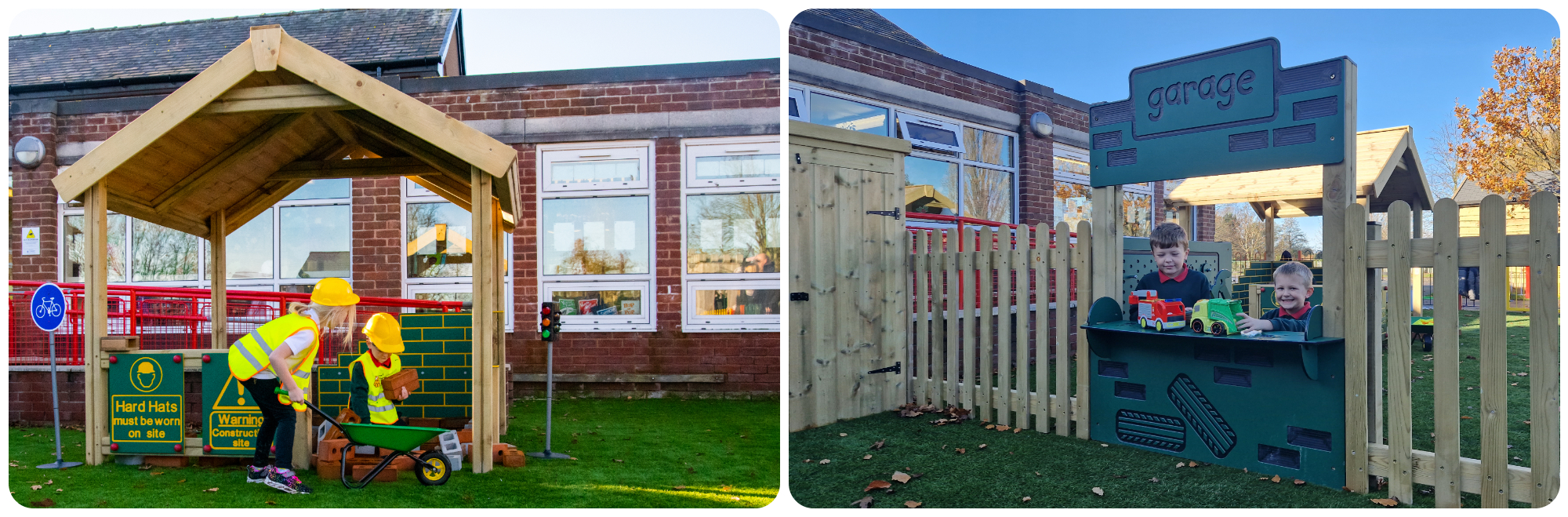
Imaginative play equipment is particularly effective in supporting this. ‘One of the best enablers of role-play are shop fronts, which lead children into assuming real-world roles and engage others with purpose. By pretending to be a shopkeeper and performing tasks for customers, children begin to appreciate the value of doing things for others. It may sound simple, but by queuing when playing the part of a customer they can learn patience and the merit of waiting their turn’.
Beyond role-play, outdoor environments also support emotional growth through challenge and achievement. ‘Well-rounded personal, social and emotional development requires much more than role-play alone’, admits Tim. ‘Growing a healthy confidence for interacting with the world and their peers is paramount to overcoming behavioural issues that can result from feeling like an outsider or less able than others at activities’.
He continues: ‘Early years foundation stage is, somewhat literally, when many children take their first steps into a larger world. They need to be challenged, tested and made to embrace new experiences. That’s how progress is made, and confidence achieved’.
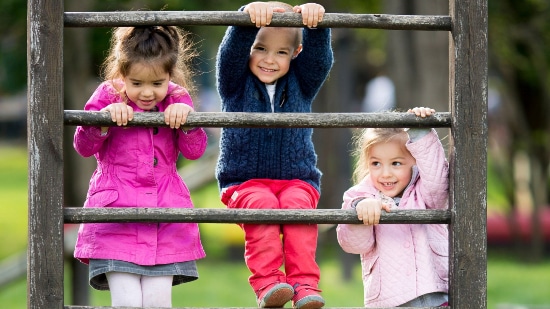
Physical challenge also plays a key role in building resilience. ‘While virtually all outdoor play equipment offers a challenge the first time they are encountered, items that involve height seem to offer a particular psychological trial. A log bridge or zig-zag beams may only be a foot and a half off the ground, but the first time a child attempts a crossing is likely one of the most awe-inspiring encounters of their life so far’, proffers Tim.
‘In fact, the first ten or so times they do this can make for a thrilling experience until they start to master it and gain the confidence to do so without considering it a major hazard. As a result, a child can achieve a sense of independence via resilience and perseverance’.
This is often where differences between environments become most visible, particularly in how confidently children engage with others and respond to challenge.
Outcome: Personal, Social And Emotional Development
By the end of the EYFS, and as set out in the ELG criteria, children will typically demonstrate personal, social and emotional development through outdoor play by:
Building positive relationships by learning to cooperate and interact with peers
Developing an understanding of turn-taking, patience, and shared activity through structured and imaginative play
Showing confidence in trying new activities and persevering when faced with challenge
Cultivating independence and resilience through repeated exposure to manageable physical and social challenges
4. Literacy
The EYFS framework explains that although language comprehension begins at birth, skilled word reading develops later in the preschool period. This involves ‘both the speedy working out of the pronunciation of unfamiliar printed words (decoding) and the speedy recognition of familiar printed words’. As a result, schools have a responsibility to support early literacy development and encourage a lifelong interest in reading. This supports the transition from early language development into early reading and phonics-based learning.
How Children Develop Literacy Skills With The Assistance Of Outdoor Play Equipment
‘Aside from the wonderful versatility offered by chalkboards, one of the primary choices of outdoor play equipment when it comes to literacy for the under-fives is a phonics panel’, offers Creative Play’s Tim. ‘Which exposes children to letters every time they enter the play area’.
Outdoor environments can also reinforce early literacy through context-based play. ‘Play town panels such as a fire station, garage, post office and a doctor’s surgeryallow children to role-play using the words they have been reading and hearing in class. Putting what they have learned into practice during playtime, a period they don’t consider to be about learning, really elevates their comprehension and use of language to another level’ says Tim.
These experiences are particularly valuable for language reinforcement through social interaction. He highlights that ‘it is important children get the opportunity to speak with one another in this way, as sadly not all youngsters have the chance to practice talking with others their age outside of an educational facility’.
Outcome: Literacy
By the end of the EYFS, and as set out in the ELG criteria, outdoor play equipment supports literacy development by helping children to:
Understand and use recently introduced vocabulary during discussions and role-play
Form correctly shaped and legible letters of the alphabet
Produce writing that can be read and understood by others
5. Mathematics
Far from the confines of scribbling in textbooks surrounded by four walls, the EYFS framework acknowledges that mathematics is also about children developing their ‘spatial reasoning skills across all areas of mathematics including shape, space and measures’. It also highlights that ‘it is important that children develop positive attitudes and interests in mathematics, look for patterns and relationships, spot connections… and ‘have a go’… and not be afraid to make mistakes’. This is particularly evident within early mathematical development in continuous provision, where concepts are embedded through play rather than direct instruction.
How Outdoor Play Equipment Helps Children Develop Mathematics Skills
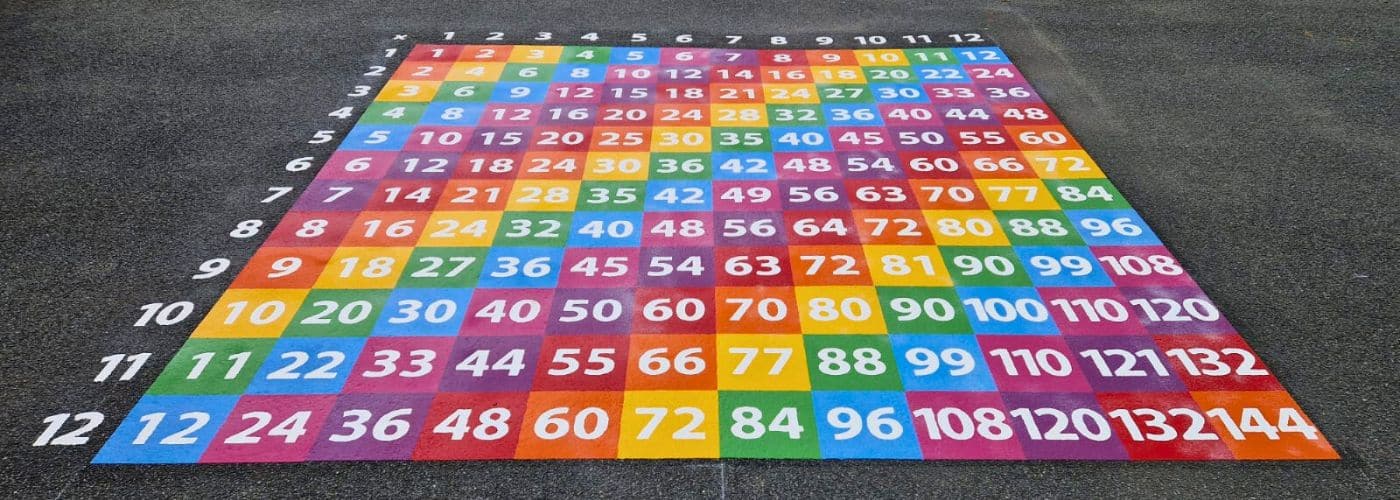
‘Some colourful floor markings can be an amazing asset for early years children to develop their maths skills,’ says Tim. ‘Snakes and Ladders is a favourite as it encourages the use of a dice – children learn to recognise numbers, count out their steps, understand rules, and even work in teams, all while being physically active’.
He adds: ‘The visual impact is really great, the colours are so appealing it gets them interested in the activities. However, the true power of the colourful aesthetic goes much deeper, it is a tool to aid learning by making numbers and letters more memorable to children’.
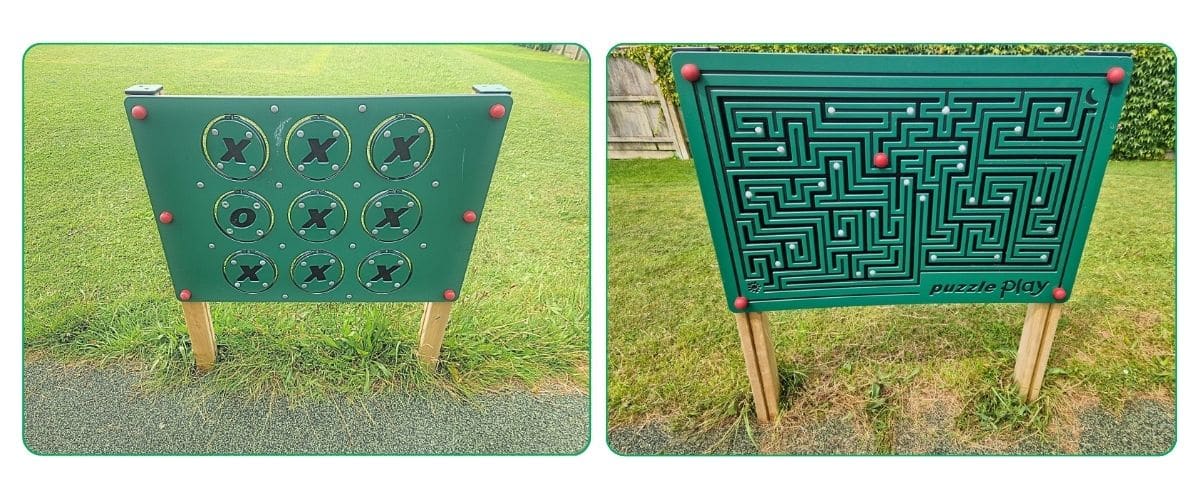
Outdoor environments also support mathematical thinking through structured and imaginative play. Activity playboards, chalkboards, and role-play equipment such as shop fronts (including cafés, markets, train stations and banks) all provide opportunities for children to explore counting, sorting, comparing, and simple problem-solving in practical contexts.
In practice, this is most effective where mathematical thinking is embedded naturally into play, rather than treated as a separate or adult-led activity.
Outcome: Mathematics
By the end of the EYFS, and as set out in the ELG criteria, outdoor play equipment supports mathematics development by helping children to:
Develop a secure understanding of numbers up to 10
Count reliably and solve simple problems
Recognise and describe patterns, shapes, and spatial relationships
Use mathematical language in play (such as more/less, bigger/smaller, next to, behind)
6. Understanding The World
‘Understanding the world involves guiding children to make sense of their physical surroundings and community’, says the EYFS framework. ‘The frequency and range of children’s personal experiences increases their knowledge and sense of the world around them’. As a result, children should be supported in developing awareness of key roles in society such as nurses, police officers and firefighters. This area contributes to children’s developingcultural capital, particularly through first-hand experiences of community roles and the natural environment.
The framework also highlights that experiences which introduce cultural, social, technological and ecological diversity ‘extends their familiarity with words that support understanding across domains’, contributing to wider vocabulary development and future reading comprehension.
How Outdoor Play Equipment Assists Children With Understanding The World
‘There’s a broad range of play activities that can help children understand the world around them’, says Tim. ‘Something as simple as weaving posts can show a child how they can physically change their environment, helping them grasp some rudimentary concept of construction and that what they do influences their surroundings’.
He adds that role-play equipment is particularly effective for helping children understand community structures and social roles. ‘Of course there are also the various shop and services play boards which allow them to understand their community and roles within it. Opportunities for role-play have a big part in this portion of their learning. Playing on a ship or pretending to be a pirate doesn’t just offer up fantasy, it provides openings for teamwork and peer interaction in which they get to flex their burgeoning ideas of diplomacy, negotiation and instructing others’.
Everyday safety and real-world awareness can also be introduced through outdoor play environments. ‘Something else that a few children might not be getting much experience of is road safety. Many children are driven to school and don’t find themselves facing pedestrian road etiquette until they are older. By including play town traffic lights and signs, floor-painted zebra crossings and motor car play panels, early years children can get their first notions of how roads work, and how to safely cross them’.
Outcome: Understanding The World
By the end of the EYFS, and as set out in the ELG criteria, outdoor play equipment supports understanding of the world by enabling children to:
Talk about different roles in society and understand basic community functions
Recognise aspects of the past through characters, stories, and role-play scenarios
Describe their immediate environment using knowledge from observation
Make observations about the natural world through hands-on exploration
Identify different environments, understand simple processes, seasons and changing states of matter
7. Expressive Arts And Design
An awareness and involvement in arts and culture plays a significant role in sparking imagination and creativity. According to the EYFS framework, ‘it is important that children have regular opportunities to engage with the arts, enabling them to explore and play with a wide range of media and materials. The quality and variety of what children see, hear and participate in is crucial for developing their understanding, self-expression, vocabulary and ability to communicate through the arts’. This area is typically developed through both adult-led and child-initiated learning opportunities, particularly within outdoor continuous provision.
They continue, ‘the frequency, repetition and depth of their experiences are fundamental to their progress in interpreting and appreciating what they hear, respond to and observe’.
How Outdoor Play Equipment Aids Children With Expressive Arts And Design
He adds: ‘As a result, by the time they reach school and are introduced to musical instruments the concept isn’t alien to them. There’s an embedded confidence for using items to make sounds and a general enthusiasm for tackling new situations without fear’.
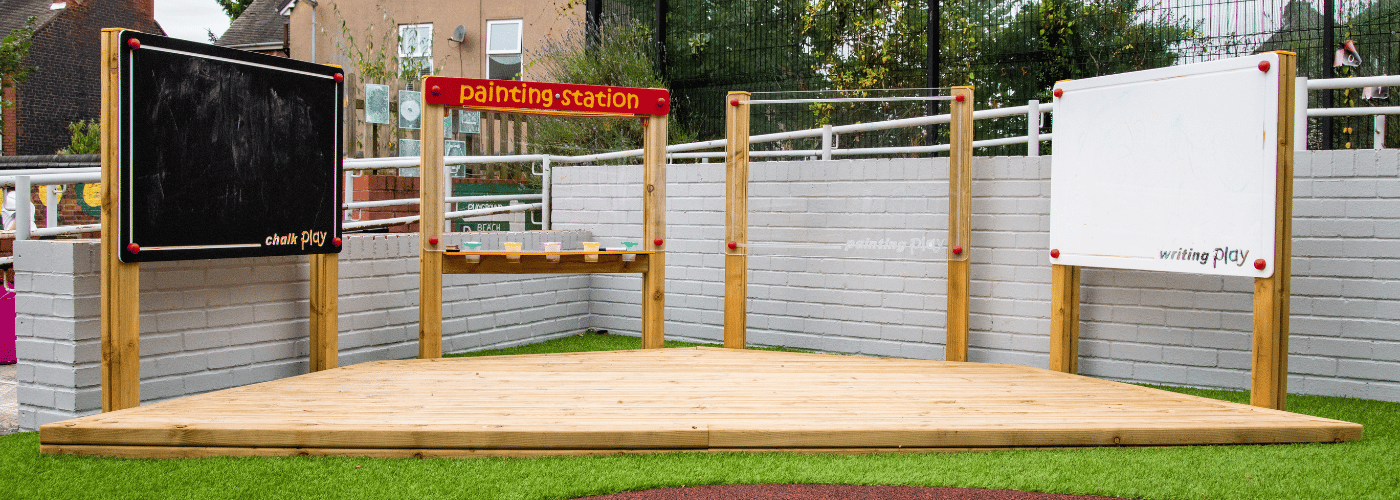
Creative expression is also supported through visual and physical media. ‘Of course, when it comes to making touchy-feely connections with art and expression, we would be remiss not to mention paint boards and chalkboards, which offer fantastic opportunities for realising ideas into the world’.
He also highlights the importance of performance-based play. ‘Let’s not overlook less tangible assets’, he advises. ‘Offering children a small outdoor stageaffords them the chance to stand up in front of their peers and express themselves both physically and verbally’.
‘Even if they are only mimicking what they have seen elsewhere, being on a stage adds the extra dimension of “performance” to their understanding of interactions, the idea that communication is not limited to being a dry, functional necessity used solely for getting through the day’.
Outcome: Expressive Arts And Design
By the end of the EYFS, and as set out in the ELG criteria, outdoor play equipment supports expressive arts and design development by enabling children to:
Use a range of props and materials during imaginative role-play
Create, adapt, and recount their own stories with peers
Perform songs, stories, and movement in front of others
Explore sound, movement, and visual expression through outdoor resources
Conclusion
When viewed collectively, these areas provide a useful lens for reviewing how effectively outdoor provision supports learning across the EYFS, and where there may be gaps in consistency or depth.
Outdoor play equipment plays a pivotal role in the holistic development of children within the Early Years Foundation Stage (EYFS). When integrated into daily learning environments, it goes beyond physical activity, supporting development across all seven areas of learning in a natural and engaging way.
Well-designed outdoor spaces provide meaningful opportunities to develop communication and language skills. Children learn to express themselves, engage in conversation, and build vocabulary through interaction and shared play experiences.
Physical development is equally supported, with outdoor environments offering opportunities to build both fine and gross motor skills, coordination, balance, and spatial awareness. These foundations are essential not only for early physical competence but also for later academic skills such as writing and numeracy.
Importantly, outdoor play also supports personal, social and emotional development. Through interaction, collaboration, and shared challenges, children learn how to build relationships, manage conflict, and develop resilience, confidence, and emotional understanding.
Across all areas, outdoor provision plays a key role in ensuring that learning is effectively embedded within continuous provision and curriculum intent. It provides a foundation that supports children not only in preparation for school, but in developing the skills and attitudes they will carry forward into later life.
When reviewing outdoor play provision, it can be useful to consider how consistently these behaviours and interactions are visible across your setting, and where there may be opportunities to strengthen them.
Reviewing your outdoor play provision
If you’re considering how your outdoor space supports EYFS learning and development, it can be valuable to take a structured view across all seven areas.
Our team works with schools to review existing play areas and identify practical ways to strengthen learning opportunities outdoors.
We use technologies like cookies to store and/or access device information. We do this to improve browsing experience and to show (non-) personalised ads. Consenting to these technologies will allow us to process data such as browsing behaviour or unique IDs on this site. Not consenting or withdrawing consent, may adversely affect certain features and functions.
Functional
Always active
The technical storage or access is strictly necessary for the legitimate purpose of enabling the use of a specific service explicitly requested by the subscriber or user, or for the sole purpose of carrying out the transmission of a communication over an electronic communications network.
Preferences
The technical storage or access is necessary for the legitimate purpose of storing preferences that are not requested by the subscriber or user.
Statistics
The technical storage or access that is used exclusively for statistical purposes.The technical storage or access that is used exclusively for anonymous statistical purposes. Without a subpoena, voluntary compliance on the part of your Internet Service Provider, or additional records from a third party, information stored or retrieved for this purpose alone cannot usually be used to identify you.
Marketing
The technical storage or access is required to create user profiles to send advertising, or to track the user on a website or across several websites for similar marketing purposes.